Thursday, January 23, 2014
Playing Catch-up!
Hey All,
We've been totally remiss about posting and keeping our friends and family up to date. The downside to getting the ball rolling is that, er, the ball KEPT rolling, and we found ourselves more involved with crop plans, joining forces with a girls' camp in Pittsford, and moving our whole farming operation a few miles north to a new location. We'd hoped to do a monster update here, but, uh, well, the weeding rarely waits. For a more current appraisal of what's going on in our lives, you might join us here on our Facebook page:
If you are not a Facebook user, we still love to get emails and letters (yes, Yvonne has been known to write back, too).
Thanks everyone for the interest and support you've shown over the past 5 years!

Monday, October 12, 2009
Fall Update

Hi all! As you know by now, Summer has relinquished her crown, and we are swiftly moving into the post-equinox days of Autumn. Not that we dislike Autumn (it's Yvonne's favorite season), we're just doing our best to keep up with the seasonal changes and their attendant chores. However, we always do our best to value the unique quality of every season, even as we run for more row covers to keep our late-season crops from taking frost damage.
After the relatively cool and rainy summer, tales of early freezes became one of our pressing concerns. One evening in mid September, we realized that we had about six crops to cover. This translates in area to about one third of our half-acre. Although this isn't an enormous amount of land to cover, we live in a spot that's often windy. After our various adventures in Spring trying to cover summer crops with 40 mile an hour winds whipping our Agribon row covers like a skinny sail while we tried to get them to cover our summer crops, we were feeling somewhat depleted of enthusiasm. Remembering that some of our neighbors had volunteered help if we ever needed it, we did take a few moments to leave a short phone message for friends of ours in Wallingford. Although certain that their cheerful offer was a kindly platitude, perhaps my call would be regarded as an incitement to our friends to get together at some future date. Farm work, after all, was still the province of farmers.
Imagine our surprise later while sizing up some row covers for our cucumbers when we heard a friendly voice hail us from the area of our workshop. Two friends were there ready to assist us, and their spouses were on the way to join them.
With a total of six adults on the task, we were able to cover five vegetable crops and one patch of zinnias in record time. Frost protection in place, we adjourned to the kitchen to begin happy hour and make plans for a dinner get-together. We were grateful and impressed. It was one thing to know that we could make sales to friends and neighbors and get their support as customers; it was quite another to know that they'd happily give us their time and effort. Sometimes, difficult situations let you know who's in your corner.

Speaking of difficult situations, we have had all sorts of mixed blessings as we attempted to divine which planting procedures, crops, fertilizers, pest control methods, and weed suppression tricks will yield the best results. Sometimes we find the right answer, but our application comes too late: as when we discovered Spinosad was exactly the right organic pesticide to apply to voracious Colorado potato beetles. Although we were able to control those ravenous little freeloaders, not before they had totally destroyed the greens of our potato plants and stripped our eggplants down to the soil. When Ed brought the plague of orangey insects to heel, they were making for our tomatoes. Lesson learned: Do your research before the clouds gather.
In some instances, it just didn't matter how prepared we were. We were very excited this year about our tomato crop, having carefully selected a mix of heirloom, cold-hardy and visually attractive tomatoes for sale this summer. We were especially excited because although other growers we know had suffered tomato losses from early and late blight, our tomatoes were bearing fruit and ripening into a luscious palette of reds, greens and warm yellow. Anticipating the chance to arrive at the Farmers' Market with yet another colorful, lively crop, Ed noticed that the foliage on the tomato plants was wilting a mere two days before that week's market. Sadly, these were the signs that we'd been dreading: the arrival of late blight, a fungus that spreads easily by wind-borne spores. Even if we picked every tomato right away, we couldn't take any of the fruit to market for fear of spreading the spores to other vendors' produce.
Despite the disappointment of losing a crop, we count ourselves lucky in many ways. We still made our financial goal for our first season without a tomato, cucumber or eggplant crop. We gained a new customer in Blue House Bakery, a local business that bought our honey by the gallon. We participated in three events promoting local produce. Best of all, even on mornings bringing rainy, blustery chills, we were still visited by regular customers offering friendly encouragement. Certainly, some of the best payment for our efforts has been in the currency of community.
Tuesday, June 2, 2009
Spring/Summer Update

Whew! Does anyone remember May?? We don't. Guess it's time to catch up.
A lot has happened in the last month and half; most of it has been good, but it's been one of those 'feast or famine' deals, and right now, we ain't starvin'. Joined in our concerns for living sustainably, Ed and I became part of a group of fellow Unitarians who all want to reduce our carbon footprint on the environment. Back in Fall of 2008, the bunch of us all obtained the book Low Carbon Diet and then held Friday night meetings to discuss energy saving methods and chart the progress of our efforts. Because we chose to meet in the evenings, our meetings are always followed with a potluck dinner. The honor of hosting fell to us on May 1st. This was something of a hosting challenge, being our largest home gathering to date. Ed's tour of our solar hot water heating system made a favorable impression with the result that two of our friends plan to install a system comparable to ours.
The following Sunday, Yvonne danced at a benefit in downtown Rutland for breast cancer research. The theme was a Gypsy Tea Party, so Yvonne was able to draw from her Roma style studies and put together a little half-time show for the intermission. The show was well attended, plus our friends from Middlebury Mitch Kramer and Dinah Smith attended. It was great to be involved in a local event, and Yvonne is looking forward to more opportunities of this type.

Did we mention that we wrote sermons? Both Ed and Yvonne delivered sermons on separate Sundays to the congregation of Rutland Unitarian Universalist Church. Did we mention that our Sundays were back to back? May 24th and May 31st? Or that between those two dates (Saturday, May 30) we actually started selling our produce at the Rutland Farmers' Market? This has been our favorite accomplishment by far this spring (No. We don't know if we're going to change the name of this blog). At least one year in preparation, we are now actually selling our produce to fellow citizens of Rutland county. How cool is that?

We started the growing season with lovely butterhead-style lettuces, leafy greens, radishes, and a handful of herbs. At the present, lettuces are waning in the hotter weather, but the onslaught of zucchini and summer squash is just starting. Soon (if we get any sun for more than 48 hours) we expect to have tomatoes, cucumbers and basil in abundance. Also, we'll be harvesting and setting out our garlic to dry.
Although we are very busy, we are grateful for the opportunity to become part of the local agricultural community. We have had the pleasure of selling vegetables to many of our neighbors, colleagues from Rutland Universalist Unitarian Church, and the pleasure of seeing friends from RAFFL, the Rutland Farm and Food Link. Ed has also mentioned that the direct marketing to customers "in person" was the one crucial element missing from his days as a farm hand on his family's farm in Illinois.
So much to share in these (sometimes) sunny days of summer. More as we have time to write it down...
Wednesday, April 15, 2009
The Hoop House is Up!
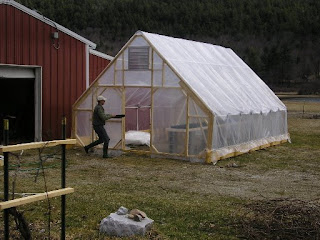
Hey everyone! Check it out! Ed finished the hoop house! As you may imagine, this represents a major accomplishment for our future farm. With a lot of persistence and ingenuity, we now have the equivalent of an enormous cold frame for hardening off our seedling plants. So far, the placement of the hoop house at the southern end of the shop has proven to be a wise bit of planning; the shop protects the structure from southerly winds, and we get the maximum benefit of summer solar heating.
We have been anticipating spring with tortured longing this year; Even though the daylight hours are waxing, temperatures in our area have steadfastly averaged out around 50 F with night time temperatures dropping down as low as 15. Self-conscious about our Flatlander status, we retained an almost British "stiff upper lip" when discussing the weather with locals. As it turned out, our stoic efforts were returned with unbridled exasperation about the ongoing cold and wind. It seems Vermont natives have had enough, too. Bonding discussion of the presence of blooms, higher temperatures, and wearing fewer than three layers of clothes have ensued. So good to know that we're all in this together.

Few times of the year say "carpe diem!" like early spring, though. Hints of green in the landscape outside mean more vigorous industry at the homestead. Our goal to sell our vegetables at the 2009 Rutland Farmer's Market draws ever closer. Although certain crops benefit from being started in a warm germination shed, there are cool weather vegetables that thrive from direct seeding in the field. This past week saw Ed plowing like a nut to break ground for new planting beds and rows. Both of us were jointly engaged in planting seed for snow peas, mizuna, 4 varieties of carrots, 6 varieties of lettuce, 2 types of broccoli, 3 types of kale, chard, 2 types of arugula and a completely new crop mountain orach (it's so cool: it's magenta!). Then Ed made the encouraging discovery that some plants (mache and lettuce) that he shielded from the snows with row covers survived the winter! Makes us think we might be getting the hang of this; more news from the front soon.
Tuesday, March 10, 2009
In Like a Lion...
 So what else is new? Plenty! We begin the month of March by celebrating our first produce sale! Just last Tuesday, we were having dinner with friends on the Rutland Natural Foods Co-op board, and one of them mentioned that butternut squash was really expensive in the winter. Almost simultaneously, Ed and I both asked, "How much do you need? We've got plenty." As it turned out, after we weeded out the most attractive and largest squash, we had about 42 lbs of the prolific cucurbits. That Thursday, we drove in to Rutland to deliver the goods and to drop off some pumpkins to donate to the Rutland Open Door Mission as well. Both of us are really jazzed to have opportunities like these to contribute to the local community.
On the market farm front, Ed has immersed himself in two important construction projects. Inspired by farmer and writer Elliot Coleman, Ed has begun construction on a small hoop house/greenhouse for starting young seedlings.

One of our setbacks last year, having moved from Middlebury in late March, was not being able to get seeds started until well after most farming operations have young plants ready for the greenhouse. Although we didn't intend to sell vegetables our first year in Wallingford, it would have been helpful to get as much time learning about growing conditions as we could.

This year, during the snow-laden months of December and January, Ed ordered soil-blockers for creating little dirt cubes for planting seeds. The great news is that the soil-blockers (which look like sophisticated cookie-cutters) come in different sizes. As the plants get bigger, you can insert the tiniest blocks (about the size of a large sugar cube) into larger cubes of soil. This gives the young vegetables more root space without the unnecessary boundary of a peat pot. Then one fine day, we move the stronger plants out to the hoophouse to harden off. Next stop: the field!

The second construction project currently underway is the creation of a small 8' x 8' insulated room for refrigerating fresh veggies.

While this project has less of the conservatorial "charm" of building a greenhouse, its success is crucial to the viability of our venture. One thing I've learned about gardening and small-scale farming is the crops are ready when they're ready. A walk-in refrigeration unit is an important business investment. Luckily for us, Ed has both the know-how and impetus to get these jobs off the "to do" list and into the "done" pile! Meanwhile, I'll be misting dirt cubes and planting seedlings with anticipatory enthusiasm.
Wednesday, February 11, 2009
Bee update
No pictures, but it was (briefly) warm enough today to open up the hives and take a quick look. This was the first day we've hit 50F since October. Executive summary: we're 4 for 4 so far, with ample stores of honey on all hives.
I shoved some fondant into the two swarm hives; they are our weakest, since they were started late last summer. I didn't do anything more than open the tops, confirm there were live bees in each hive, toss in the fondant, and close them back up.
Eleanor's hive had a bit of mold on the inner cover, so I added some spacers to improve the airflow. Airflow through the hive is very important because the bees stay warm by balling up, eating honey, and vibrating. They keep the hive interior 80F in winter, and 92-93F in late winter when they start raising brood again. The moisture from their respiration can build up if there is insufficient airflow, and can actually cause ice to form on the inside of the hive. The technical term for that is 'bad'.
When we get a warmer day we can take a closer look and get an idea of the size of the bee populations in each hive. We're expecting to have to split Louise's hive to prevent them from swarming. But that will wait until at least May. Today was the last warm day for the foreseeable future.
Thursday, January 8, 2009
Gaea's Downtime

Perhaps the biggest lesson I've learned from living in Vermont is to embrace winter. It's really easy on the days when snow is drifting quietly and laying a powdery blanket over the landscape. After all, the busy days of harvest are behind us, and though holidays bring a rush of activity, ideally they, too, can be an opportunity to count blessings, appreciate others, and look forward to the nascent year. So, although we're not outside every day weeding and watering, we have this season of contemplation to lay plans for new projects.

I also wrapped up an enlightening internship with the Smokey House Center. During the last weeks of the program, I had an interesting encounter with the local fauna. Outside the Conference Barn, I found a little black-capped chickadee sitting on the ground. The chickadee didn't react when I got near her, so I thought she must have slammed into the patio-sized glass windows in the front of the building and was stunned. I picked her up to see if she was injured. No blood, no obvious injuries. She wrapped her tiny talons around my fingers. Fortunately, Fran, my fellow intern happened to know where the SHC digital camera was. Here's a picture of me sending the Chickadee to be back with her pals...

January is aptly represented by the Roman God Janus, guardian of gates and doorways, since winter brings us both endings and beginnings, comings and goings. With that in mind, 2008 had some farewells (Chuck Berry, Miriam Makeba, Eartha Kitt, Yma Sumac), but saw the beginning of new lives, events and friendships (Isa, Megan, the Safford Family Ski Trip). Of course, I can't leave out our new Commander and Chief!! I think this next Inauguration will be the most historical event I'll witness, unless the gods have something really big in store...
Winter is a great time for drawing up crop rotation diagrams, solidifying a business plan and perusing seed catalogs! We had great success with seeds purchased last year from High Mowing Seeds, a producer of organic vegetable and flower seeds based in Wolcot, Vermont. Paging through the colorful sections of the HMS catalog, it's hard not to long for brighter days and higher temperatures.
Still, winter is the best time for me to pursue intellectual pursuits that I can't give as much focus to when I've got irrigation lines to lay. My Yule present to myself this year will be to buy a book/cd set for learning Finnish. I've waited a long time to continue my language studies. Besides, gotta be ready for those cultural exchange opportunities when they appear. Here's to discussing the Kalevala in the sauna...
Wednesday, December 3, 2008
Breaking Ground

We're working on opening up a new quarter acre plot for vegetable production next year. In the middle (between the two strips of black garden cloth) is a mulched bed of garlic. We planted the garlic in late October for next summer's harvest.
This shot shows the results of one pass with the rotary plow. It does a pretty good job of breaking up the sod, but we'll need to do at least another pass with the tiller attachment to get a workable seed bed. The wavy course of the furrow is due to the rock in the soil that makes the tractor and plow jump around some. After each pass I go back and pull out all the rock I find.
Here's a shot of the pile of smaller rocks that we've recovered thus far:

Saturday, November 29, 2008
Harvest Wrap-Up

Thought it would be good during Thanksgiving break to take a breather before the Holiday Rush begins in earnest. Truthfully, though, the year has been pretty great. Ed and I are looking forward to a Thanksgiving potluck in Pittsford with fellow members of The UU Church of Rutland.
Well, of the many things we learned this year one thing was clear: We can grow squash! Our yields for butternut squash and pumpkins were particularly high. The pumpkin harvest alone was approximately 75 pumpkins, with the largest one weighing in at 58 lbs! One of the best things about both are how easily we are able to store them over the winter.

The other great thing is how Ed has taken the lead in discovering great soups to make with pumpkins. With the invaluable help of Mollie Katzen's wonderful vegetarian cookbooks, we've made some super discoveries.
We have also gotten some good things accomplished before the winter begins in earnest. I got a handful of bulbs in the ground before the ground froze. I am wondering if cut flowers might be a potential business along with our other market farm endeavors. We'll see. I found out about a great garden supply source that sells heirloom varieties of bulbs; they also put together packages suited for different growing regions of the U.S. I decided to start with their selection for Zone 4b and see how well the bulbs survive the winter. Here's hoping!
Another great opportunity that's come my way this year is working with local potter Carl Buffum at Wallingford Pottery right in town. I've taken on some of the grunt work such as mixing clay and stacking the kiln for firings in exchange for some studio time on the wheel.

I started out working with clay left over from my classes at Frog Hollow, however, all of the glazes I've used so far are Carl's. It was fun experimenting with these. Since I have a tendency toward shiny, glassy glazes, I don't usually spend a lot of time on manipulating the surfaces of my pieces. However, Carl uses one basic white matte glaze that really emphasizes the the texture of the clay body. In the pictures here, it is possible to see how much the glaze moves around to cover the surface of the pieces. Although Carl is getting ready to close down the studio for the year (the larger workplace is in a screened-in porch), I am already looking forward to doing more next spring.

Saturday, November 1, 2008
Smokey House

Hi All. Between the post growing season wrap up and taking time to appreciate the beautiful fall colors, I haven't written much about what I'm doing for work right now. At present, I have the privilege of working at The Smokey House Center, a remarkable educational center and working farm located in the awe-inspiring beauty of Danby, VT. With over 5,000 acres of reserved land set aside for its mission, the staff work to teach youth practical skills in sustainable living. Founded with a principal of work as an enhancement to education, all teens enrolled in the programs here are required to report to team leaders, learn group skills, and keep their grades up. It is exciting to see what's going on here, and also take part in some of the daily activities.
My specific title is "Energy Efficiency Intern". I am researching ways to "zip up" some of SHC's buildings so that the organization can save on fuel costs. What that translates to in my work day is: caulking! However, that's great, because ever since my VWW Women's Carpentry Class, I've become more interested than ever in sustainable and energy efficient architecture.

When I'm not doing online research or spending quality time with my caulk gun, I have had the opportunity to really appreciate what a truly beautiful state VT is. Gotta say, driving to work on the Beltway really couldn't hold a candle to this.
Thursday, October 2, 2008
Time out for Chuckles

Huzzah! We caught Chuckles today. This juvenile groundhog, whom we dubbed Chuckles, had taken up residence in our run-in shed. Through creative means we convinced him/her to move elsewhere. Unfortunately "elsewhere" ended up in a burrow under our garden shed inside our garden's perimeter electric fence. Dang. So we got a live trap. Turns out apples are a primo bait for wood chucks.
So after taking this picture, I lugged Chuckles down to the creek and freed him/her in our lower wood lot. Hopefully it's well enough away from the garden that we won't have a Chuckles sequel.
Tuesday, September 30, 2008
Power Up

Above is our latest green/sustainable/energy-saving initiative. Davis, owner of Bright Earth Solar, and his sister Rian just finished installing a dozen photovoltaic (PV) panels on the roof of our shop. The panels are mounted on a fixed frame and are capable of generating a maximum of about 2.5 kilowatts. Over the course of a year this array should produce enough power to offset about 60% of our current electrical load. An adjustable array would have improved the efficiency somewhat, but would have increased the chance of damage in high winds.

Inside the shop is the grid-tie inverter (on right) which converts the direct current from the PV panels to alternating current in synch with the grid. The inverter connects to a meter (center) and thence to the shop's sub-panel (left), where the power back-feeds to the main panel in the house. Our power meter on the house spins backwards when we make more power than we use, which is a pretty nifty thing to see. The payback period will depend on how fast electrical rates increase here in Vermont. If they average 4% per year (which seems pretty conservative), the payback period will be approximately 20 years. But the state is already talking about a 6% increase for next year, so we shall see.
Next month Davis will be coming back to install two solar hot water heating panels on the house. That will help a lot, since we burn oil for our hot water now.
Wednesday, September 3, 2008
The Good Earth!

Here are some images from our first growing season. The cherries were planted by the previous owners. They are sour cherries, but they still make pretty fine jam and chutney if Yvonne is involved! And bees go knutz over the flowers in spring.

This is the pumpkin forest that is now elbowing out the potatoes, peppers, eggplant, and a few other things. This shot is from July. Now in early September we have many pumpkins in the 30-40 pound range turning orange. Yikes! We are thinking about hosting a Great Pumpkin party.


Above are a small cucumber and a young butternut squash.

This is our first donation (potatoes, chard, kale, squash, beans, and cucumbers) to The Mission , a local homeless shelter. We've donated over 35 lbs of produce to them so far, plus an equal amount given away to friends at the UU Church of Rutland. And our basement freezer is nearly full.
We thought briefly about selling our extra veggies this year, but decided the good karma of giving away the excess was probably more useful to us all in the long run. Our objective this season was to learn about our soils, pests, weeds, and climate, and to feed ourselves in the process. We have largely accomplished those goals. It has been a good summer!
Swarm 3
Sorry for not posting in a timely fashion. We've been very busy with harvests and bees.
Below is our fourth colony, now termed the duplex. Two days after the second swarm showed up, a third (also from the neighbors or a feral colony) appeared in our blackberries. That's three swarms in 10 days landing within 30' of one another. I think we're in a sweet spot for bees!
We dithered for a few days on what to do; we had very little extra bee hardware on hand. After the swarm stayed put two nights in the berry bushes, and with a forecast of thunderstorms moving in, we decided to try combining this swarm with the second swarm. We hit the bee text book and got the details on using newspaper to temporarily screen the two colonies from one another. A lot of beekeeping theory has become practice for us in a hurry!

This is a shot of the duplex with the newspaper in place. The bees chewed through it in about two days. We later inspected the hive and found the surviving queen. We named her Calamity Jane, and marked her as an '08 queen (red). (She might be older, but there's no way to know.) The race is on: these bees need to quickly lay in 60+ pounds of honey or they will not survive the winter. We're helping with sugar syrup feedings; they are sucking down a pint+ a day. There are plenty of things in bloom and the weather has been perfect, so they might make it.
Thursday, July 31, 2008
Swarm, redux
Last Tuesday (7/29) we went out to the bee yard to check on the ladies. At the same instant we both spotted this in one of the cherry trees:

Seems like we have a honey bee swarm every Tuesday now. What the heck?! I sort of expected Thelma's swarm the previous week, but no way did I think Louise's hive was going to swarm. Well, we eventually found out that Louise and her crew were where they belong -- this was someone else's swarm, or perhaps even a feral colony swarm that happened to land in our cherry tree. It was eerie that they were almost silent; a writhing mass of bugs, but silent. Trippy. They usually make quite a fair racket.

Well, I hate to turn away free bees, and we had some additional equipment (the hive body is still in primer, but useable enough in a pinch). This time we knew the drill and we were even dressed for the occasion!

Shake into hive, add top feeder, cover, and let simmer.
After we got these new arrivals housed we checked the other hives. We found eggs in Louise's colony, and eventually found Louise herself. The eggs were the key though. Bees exist as eggs for 3 days. The queen stops laying eggs at least a week before the swarm leaves, so we knew this colony had not swarmed even before we found Louise.
Over in Thelma's old colony things are going along pretty well. We found at least 4 of these beauties:

The peanut shaped thing is a capped queen cup. (The rest of the frame is mostly of capped worker bee brood.) One or more of these will hatch soon and we'll have a new queen in Thelma's old colony. We're discussing names even now. The fun part will be marking her. We practiced doing that with drones when we took the bee keeping class through the MCBA , so that training will come in very handy. It's a good idea to mark the queen so that you can find her a little more easily. Also the color indicates the year of hatch (2008 is red). Queens will live for 4-5 years, but their best egg production only lasts 1.5 - 2 years. It's really handy to know when she should be replaced -- a weakly laying queen means a weak colony.
Thursday, July 24, 2008
To Catch a Swarm

Tuesday (7/22), at approximately 1 pm I chanced by the bee yard. Thousands of bees were whipping around the air. Thelma's hive had swarmed! We had had some inkling that this might be in the works, but thought we had headed it off. Not so.
While honey bee swarms look downright biblical, they are really very manageable events if you 1) know what to do, and 2) don't panic. Swarms are the way honey bee colonies reproduce. The queen and most of the bees capable of flight (that's 15-25 thousand) make a mass exodus and search for a new home. They are very gentle while swarming because they have no home to defend. That said, when I gathered myself, I ran inside and told Yvonne what was happening. She alertly brought the camera so you get to see what happened next.

This is me and the swarm in one of our cherry trees. Eventually the swarm lands and waits for the scouts to find a new home. They may stay in the first spot for 20 minutes or 3 days, depending on what the scouts say and the weather conditions. By the way that's steely resolve on my face, not panic.

Here's a close up of the swarm wriggling in the cherry tree. That's the brim of my hat on the right.

Fortunately we had some extra bee equipment on hand for just such an occasion. I didn't figure to use it until next year, but that plan has clearly been overcome by events. I put the hive body underneath the swarm and we cut off the branch of the tree. Then we shook the bees off and into their new quarters, thus:

Once the cover is on, it suddenly looks like a normal bee yard again. Nothing to see here; move along, move along.

Today we took a look at the new hive and added some frames from the established hives. We put in a frame full of honey, and one of larva and capped brood. Folks say the presence of brood is the best way to ensure the swarm adopts the new hive as home. Predictably the bees had gotten a bit confused and were building comb from the top down. That's why they are all piled up on the inner cover. After this shot was taken I shook them down into the hive body, and Yvonne scraped the last of the burr comb off the inner cover. With luck the two drawn frames will convince them to build new comb in the right place (on the foundation, not the roof).

Hopefully the bees that remained in Thelma's old hive will have a new queen hatch out by early next week. (We added a frame of eggs from Louise's hive for insurance, so if there is no queen on the way the bees can make one now.) We'll keep an eye out for an unmarked queen next time we open up that hive. According to schedule the new queen should be making mating flights next week, and should start to lay eggs the week after that. If we're lucky we'll be able to find and mark her. Too much fun!
Saturday, June 28, 2008
Compost is the Answer...
...or at least it's a gardener's very dear friend. Compost adds organic matter and nutrients to soil, helps build soil structure, and increases the amount of water the soil can hold by an order of magnitude.
Here is a shot of the two compost piles we have underway so far, with a stack of hay in the foreground. We layer kitchen scraps and some carbon sources (paper, wood chips, and whatever else we can scrounge) in the hay and let it rot to make compost. In time we will add a third pile. The walls for the piles are just some shipping pallets that the previous owners left us.

Like all startup operations, we are compost poor this first year. We should have some finished compost by the middle of August, so that will be a start. Next year we will be in much better shape.
Our source for the hay is the grass from the pasture (most of our land is open pasture). We cut it with the sickle bar attachment on the Grillo. (The tiller attachment is the green thing parked to the left.)

The sickle bar works pretty well, though grass does tend to bunch up around the axle. The blue PTO shield needs to be a bit wider in order to lay the grass more to the sides. If I run out of things to do I'll add some arms to the faring.
In addition to composting the hay, we also apply it directly on the garden as a mulch, as this image shows:

Mulch suppresses weeds and slows moisture loss while it slowly breaks down (rots). All good stuff. In really weedy areas we lay down a layer of cardboard first and then pile the grass on top of that.
Saturday, June 21, 2008
Summer, Sawdust and Skillsaws

One of the high points of 2008 has been my opportunity to enroll in a program for Construction Skills for Women sponsored by Vermont Works for Women. I found out about it when I interviewed at the Department of Labor for a spot in the Step Up to Highway Construction program. Vermont Works for Women, a non-profit based in Winooski, VT, provides training and workshops for women exploring careers considered traditionally "male." In addition, VWW provides classes for girls to build their practical skills, express themselves creatively and expose them to professional female mentors.
Construction Skills for Women is really the title of a series of classes; the specific course that I participated in was for carpentry. The moderators of the program displayed high expectations for class participants. Each of us had to interview for the program twice, explain clearly in each interview why we thought we'd be good candidates for the program, and make a commitment to finish the program. Despite the sort of pedagogical spin with which I may have flavored this description, our program coordinators Rachel and Kristen showed uncanny insight in handling each woman's personal situation. I was repeatedly impressed with their "people sense" and ability to manage "situations" gracefully.

The educational aspects of these classes were most valuable. Though most of us hadn't really had much professional experience as carpenters, it became clear that all of us had little fear of getting our hands dirty. Classroom time Tuesday and Wednesday evenings broached topics such as what to expect from the construction trades, workplace environment, self-employment and job-finding skills. Fairly confident in my interviewing skills, I most appreciated the number of professional business owners, mostly women, who participated our class panel discussions. This generous gift of time gave me a lot of personal satisfaction. Women may not be common in construction or carpentry, but we do have a presence. Fab. I'm not ruling out power tools for Christmas yet.
In addition to great speakers, we also had the opportunity to accept on-site placements known as "job shadows." For one day (sometimes a few hours, depending on the work being done) we were allowed to work on active construction sites. I was able to do this three times during the course of the classes. Each time, I had access to a different aspect of the trade. My first placement was on site for a new bank building in Colchester. At this site, I got to use a drill, a circular saw, use a Paslode cordless nailer to set siding and operate a pneumatic lift. I also spent the second half of the day working with a really cool woman named Sylvia who had been in construction for about 14 years.
My next placement was in a private home in Addison County helping two guys finish remodeling work on an old Vermont home. That day, I got to cut and measure drywall, spray foam insulation, and briefly handle a Sawzall. I liked this job shadow for the opportunity it gave me to talk to the other guys on the job about their experiences in the field. It also pointed out to me how differently one has to behave in a domestic environment vs. a regular construction site. Navigating some of the upstairs rooms while wearing a full tool belt and work boots was a special sort of ballet.

The third job shadow I took had me working with the foreman installing cabinets in a new home. This was my first experience on a sustainable build, and I got to ask a few questions about standards, power usage, and materials. This crew was great. The camaraderie was palpable, and I never felt blown off or excluded. In fact, the day went by so fast at this site, that I was actually surprised to hear someone say that it was 4:00 pm! Never had a desk job like that.
 Rounding out the classroom discussions and exercises, Saturdays during the course we worked on an actual construction project. As a class, we built a garden shed under the fearless supervision of Amy Judd, proprietress of Plane Jane Builders. Gotta love anyone who'd ditch the office in order to contribute to the skyline of Essex Junction, VT. Amy is not only a confident carpenter, but she is a gifted teacher in numerous ways. Most valuable is her talent for maintaining an active work site where everyone, regardless of personality type, feels at ease. She is also super at letting everyone discover their strengths, not just their weaknesses. Amy was really clear about everyone jumping in and "getting out of their comfort zone."
In any event, it was a great experience. Although I haven't landed a carpenter's assistant position yet, the experience I've had working with others in construction is invaluable. I will be spending two days (Saturday July 5th and Monday July 7th) on a Habitat for Humanity build in Milton. I am scheduled to go back again on August 16th, and look forward to sharing my time and energy with the volunteers on site. While I search for a job, the opportunity to lend my arm to building homes for others sure seems like a fair trade.
Subscribe to:
Posts (Atom)